
Is Cheese Halal? Four Types of Rennet (Milk-Clotting Enzyme), and Why It Is Not Listed as an Ingredient
Category: For visitors
For cheese, check the rennet used to clot the milk
Cheese is made from the milk of cows, goats, and other animals. It may seem to use neither meat nor alcoholic drinks, but cheese is one food that people concerned about halal status may want to check. The reason is the enzyme used to clot the milk.
Megmilk Snow Brand’s frequently asked questions describe natural cheese (ナチュラルチーズ) as raw milk or similar ingredients coagulated with lactic acid bacteria or milk-clotting enzymes, with some whey removed, or cheese made by aging this. Processed cheese (プロセスチーズ) is made by finely breaking up natural cheese, heating it, and emulsifying it. Processed cheese, such as sliced cheese, also goes through a milk-clotting stage when its natural cheese ingredient is made.
This milk-clotting enzyme is rennet (レンネット, 凝乳酵素). According to J-Milk (Japan Dairy Association), natural cheese is made by adding lactic acid bacteria and rennet to pasteurized milk to coagulate it, finely cutting the coagulated milk into curds, draining whey while stirring, packing the curds into molds, adding salt, and aging the cheese.
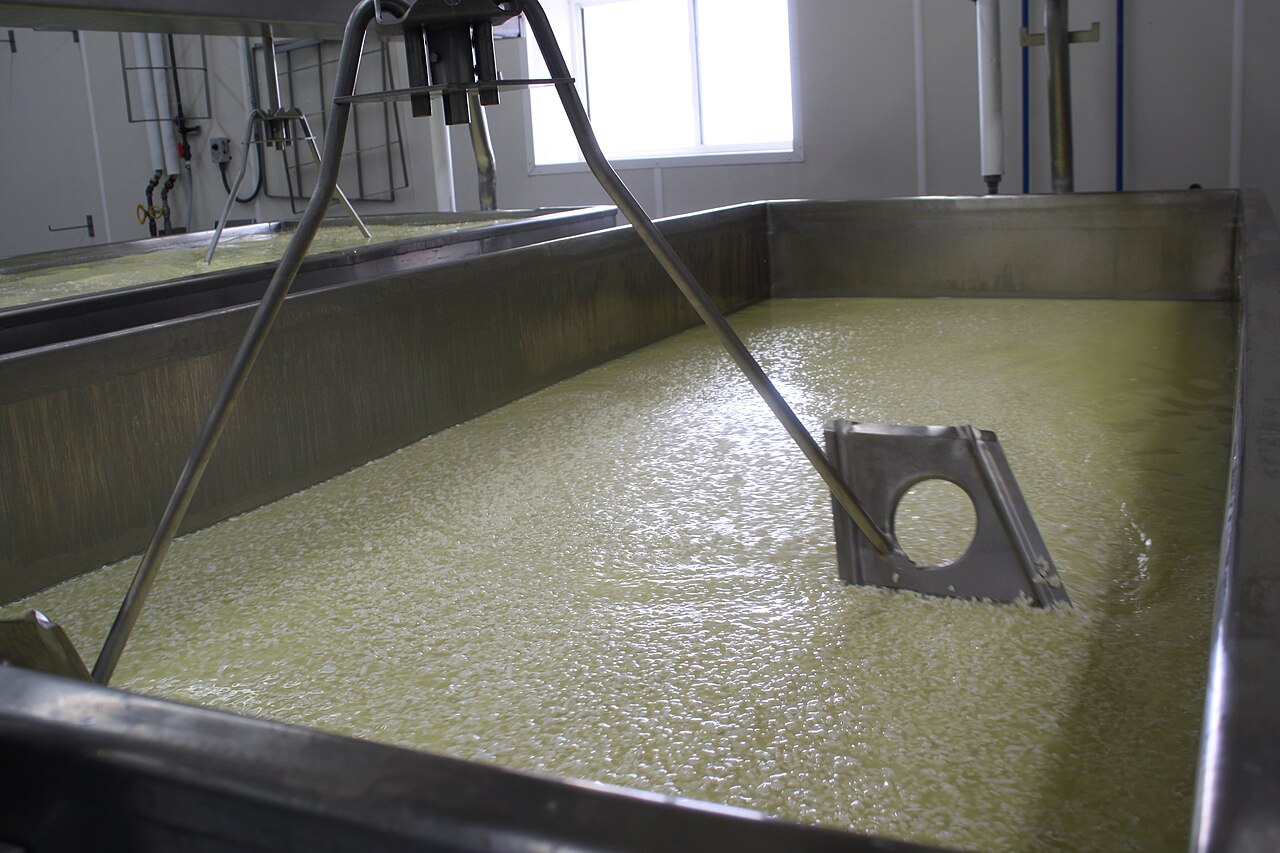
Some rennet is extracted from calves’ stomachs. The “Handbook for Exporting Halal and Kosher Food” (March 2026), published by the Ministry of Agriculture, Forestry and Fisheries (MAFF), gives dairy products in the UAE (United Arab Emirates) as an example. It says rennet used in cheesemaking must not come from pigs or animals that have not been properly slaughtered.
Using information published by public bodies, industry associations, manufacturers, and certification bodies, this article covers rennet types, how certification standards treat them, why rennet is not listed among ingredients, how to check processed cheese and whey, and what to ask manufacturers. What people avoid, and how far they trace ingredients, varies. This article provides information to help people decide; it does not determine whether they may eat something. Product names are examples to explain how to read labels. They do not mean those products use animal-derived rennet. All sources were checked on October 26, 2026.
Four types of rennet: calves’ stomachs, molds, genetically modified microorganisms, and plants
J-Milk describes rennet as a type of enzyme that clots milk and introduces four types: animal rennet, microbial rennet, fermentation-produced chymosin, and plant rennet.
Animal rennet is made by extracting milk-clotting substances from the stomachs of slaughtered ruminants, such as calves, lambs, and goat kids. Its main component is an enzyme called chymosin. According to Meiji’s food education website, calf rennet is found in the fourth stomach of milk-fed calves aged 10–30 days, and contains 88–94% chymosin and 6–12% pepsin.
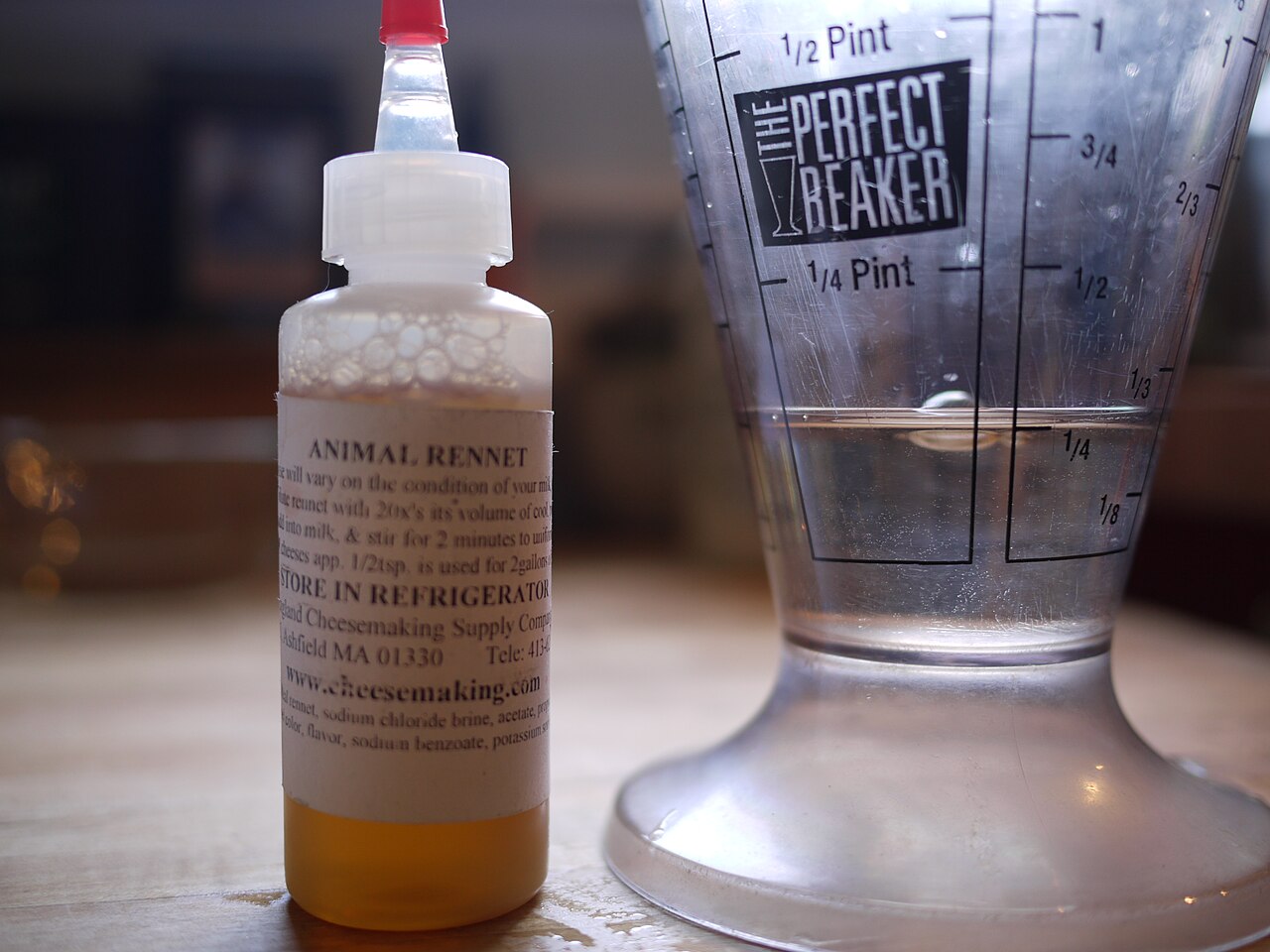
Microbial rennet is a milk-clotting enzyme produced by molds called Rhizomucor. J-Milk explains that it began to be used as an alternative in the 1960s because calves’ stomachs, the source material, were in short supply. It also says microbial rennet is inexpensive because the mold can be grown in tanks in large quantities, but tends to produce more bitterness than calf rennet.
Fermentation-produced chymosin is an enzyme made by inserting the calf chymosin gene into microorganisms such as E. coli, yeasts, or molds. It is also called genetically modified chymosin. The Q&A collection from Chizu Kosei Torihiki Kyogikai (Japan’s cheese fair trade council) says genetically modified chymosin can be used in Japan. It explains that the Ministry of Health, Labour and Welfare (MHLW) included it in its list of additives that had undergone safety assessment procedures on October 1, 2010.
Plant rennet consists of milk-clotting substances found in figs, papayas, artichokes, and similar plants. J-Milk says these have long been studied in places such as India, where religious reasons prevent the use of chymosin from cows’ stomachs.
As for which types are used, J-Milk says fermentation-produced chymosin accounts for about 60% worldwide and microbial rennet for about 30%, while animal and microbial rennet are widely used in Japan. This indicates that some cheese made in Japan also uses animal rennet.
Halal certification standards consider the animal species and slaughter method
What needs checking about rennet depends on its type.
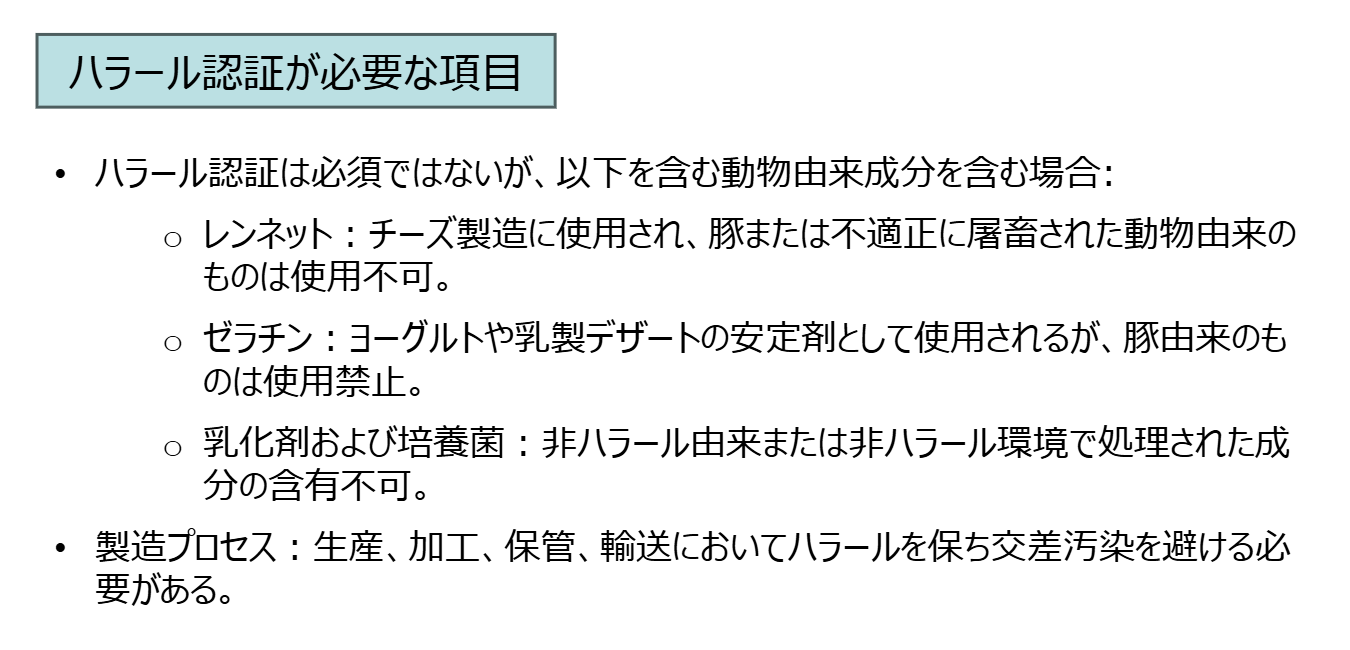
For dairy products in the UAE, MAFF’s handbook says halal certification is not mandatory, but lists ingredients of animal origin among cases that require it, including rennet. The same section says pig-derived gelatin used as a stabilizer in yogurt and similar products cannot be used. It also says emulsifiers and cultures must not come from non-halal sources or be processed in non-halal environments.
In an article published by Indonesian halal inspection body LPH LPPOM on April 20, 2023, a representative of the body explains the rennet used to clot milk in cheesemaking. Rennet may be produced by microorganisms or derived from calves’ stomachs. For microbial rennet, it is necessary to check that the culture medium used to grow the microorganisms contains no prohibited materials. For calf-stomach rennet, the slaughter method determines its halal status, according to the explanation.
Taken together, the two sources suggest different points to check for each type. For animal rennet, check which animal it came from and whether that animal was slaughtered in the Islamic way. For microbial rennet and fermentation-produced chymosin, check the materials used to grow the microorganisms. Plant rennet does not use animals.
| Rennet type | What it is made from | What to check for halal purposes |
|---|---|---|
| Animal rennet | The fourth stomach of ruminants, such as calves | Which animal it came from, and whether it was slaughtered in the Islamic way |
| Microbial rennet | Molds such as Rhizomucor | Ingredients of the culture medium used to grow the mold |
| Fermentation-produced chymosin | E. coli, yeasts, molds, or other microorganisms with an inserted chymosin gene | Ingredients of the culture medium used to grow the microorganisms |
| Plant rennet | Figs, papayas, artichokes, and similar plants | No animals used |
The handbook presents its explanation as a UAE certification example. The standards people follow when choosing food differ by country and certification body, and by individual too. We discuss how far to check beyond pork and alcohol in A List of Foods That Are Not Halal: Pork, Alcohol, and Easy-to-Miss Items in Japanese Food.
Why “rennet” does not appear in the ingredient list
You may not find the word rennet in the ingredient list on a bag or box of cheese.
The product page for Megmilk Snow Brand’s “Yukijirushi Hokkaido 100 Camembert Cheese” (雪印北海道100 カマンベールチーズ) lists “raw milk (from Hokkaido), salt” (生乳(北海道産)、食塩). The company’s FAQ explains that white mold spores are added to Camembert alongside lactic acid bacteria and milk-clotting enzymes (rennet). Yet the ingredient list mentions none of the bacteria, enzymes, or white mold. Meiji’s “Meiji Hokkaido Tokachi Camembert Cheese” (明治北海道十勝カマンベールチーズ) also lists “raw milk (from Hokkaido), salt” (生乳(北海道産)、食塩).
The reason lies in cheese labeling rules. Cheese labeling is governed by the “Fair Competition Code Concerning Representations of Natural Cheese, Processed Cheese, and Cheese Food,” based on the Act against Unjustifiable Premiums and Misleading Representations. Here, representations means labels, descriptions, and claims (表示). Chizu Kosei Torihiki Kyogikai, which administers the code, publishes a Q&A collection about it. Asked whether rennet used to make natural cheese may be omitted from labels, the collection says it can be omitted as a processing aid: it is removed with the separated whey, and any remaining amount is tiny. It also says lactic acid bacteria starters need not be listed because they are treated as “food.”
The food additive labeling materials from the Consumer Affairs Agency (CAA) also explain that additives no longer present in the finished food, such as processing aids, may be omitted from labels.
An ingredient list saying only “raw milk, salt” (生乳、食塩) does not necessarily mean milk-clotting enzymes were not used. In the Fair Competition Code’s definition introduced by J-Milk, natural cheese is also made by coagulating milk proteins with “enzymes or other coagulants.” The list reveals some of what was added besides milk and salt, but it does not tell you whether rennet was used or which type it was.
For processed cheese, check the cheese ingredient and the emulsifier
Ingredient lists are worded differently for processed cheese, such as sliced cheese and six-portion cheese. Megmilk Snow Brand’s “6P Cheese” (6Pチーズ) and “Yukijirushi Sliced Cheese (7 Slices)” (雪印スライスチーズ(7枚入り)) both list “natural cheese (manufactured overseas, manufactured in Japan) / emulsifier” (ナチュラルチーズ(外国製造、国内製造)/乳化剤).
The rennet used in the natural cheese ingredient is not listed here either. “Manufactured overseas” (外国製造) indicates that some of the natural cheese ingredient was made outside Japan. For cheese made overseas, just as for cheese made in Japan, the rennet type does not appear in the ingredient list.
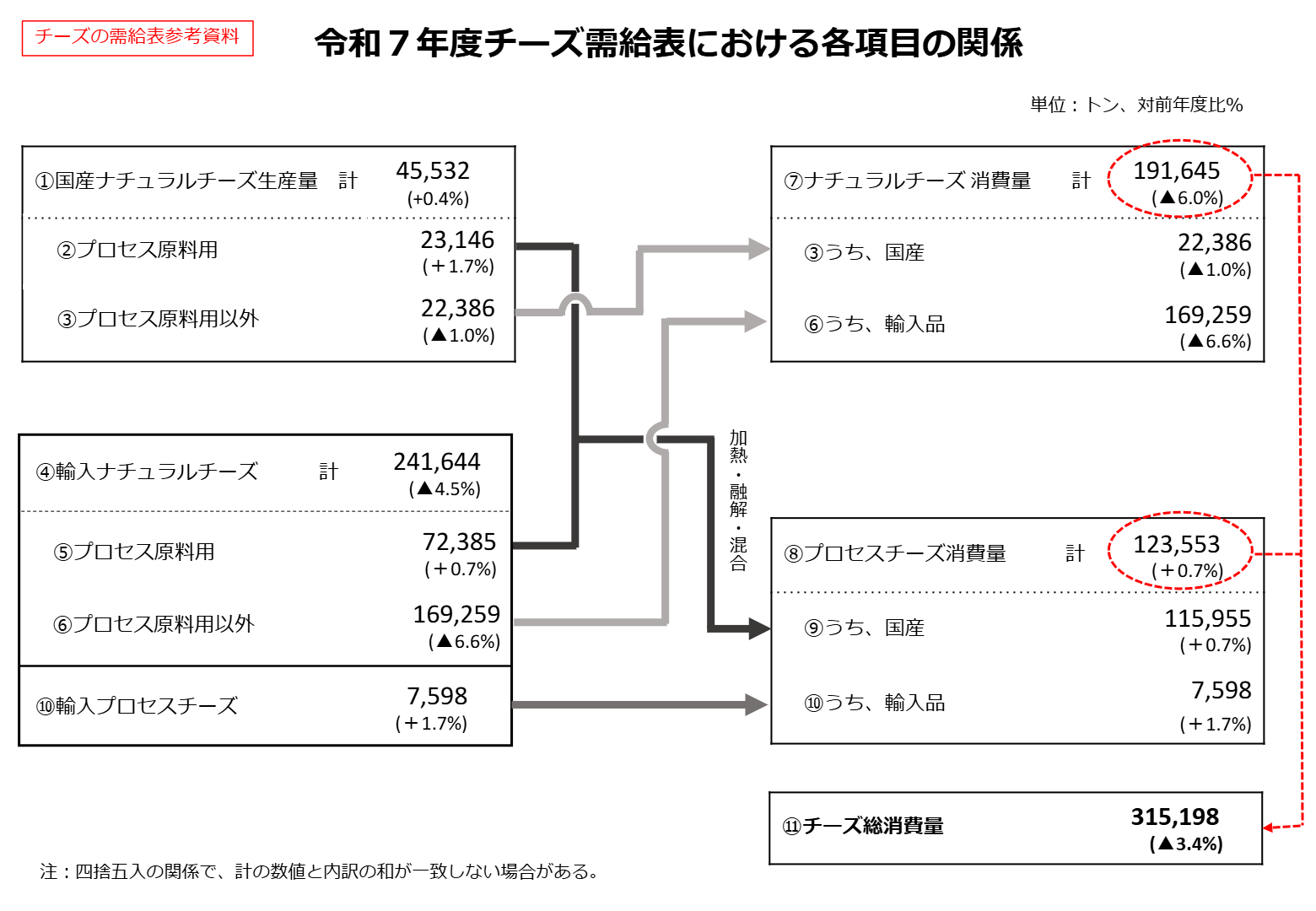
A substantial share of cheese consumed in Japan is made overseas. According to MAFF’s “Summary of the Fiscal 2025 Cheese Supply and Demand Table,” the preliminary figures for natural cheese in fiscal 2025 were 45,532 metric tons produced in Japan and 241,644 metric tons imported. For natural cheese used to make processed cheese, 23,146 metric tons were domestically produced and 72,385 metric tons were imported. Domestically produced cheese accounted for 15.5% of total cheese consumption.
Some people may be concerned about the word “emulsifier” (乳化剤) in the ingredient list. We discuss how the origins of emulsifiers used in bread and sweets are stated in Are Emulsifiers and Gelatin Halal? What the “Origin” (由来) Wording on Ingredient Lists Tells You. Emulsifiers in processed cheese have a different role. Megmilk Snow Brand’s FAQ explains that they are used to blend the natural cheese ingredients evenly, and usually consist of mineral-derived phosphates. J-Milk also describes the emulsifiers added when making processed cheese as emulsifying salts, such as sodium citrate or sodium phosphate.
For processed cheese, the rennet used in the natural cheese ingredient is more relevant to check than the emulsifier. If the cheese ingredients come from several countries, the manufacturer also needs to check each ingredient separately.
Whey and lactose may also come from cheese
Cheesemaking produces whey (ホエイ, 乳清). Meiji’s food education website describes whey as the liquid released as milk coagulates. It contains whey proteins, lactose, and mineral components, and is used in many fields, including food, medicines, animal feed, and fertilizers.
The cheese fair trade council’s Q&A collection mentioned earlier said rennet is removed along with the whey. Rennet that does not remain in the cheese moves into the separated whey.
For chocolate ingredients, the same LPH LPPOM article says lactose and whey need checking because they may be by-products of cheesemaking that could have used prohibited materials. Even in food that does not use cheese itself, seeing “whey” (乳清 or ホエイ), “lactose” (乳糖), or similar words in the ingredient list may lead back to cheesemaking when you trace their origins.
The rennet in the cheese used is also relevant to cheese-flavored snacks, bread and sweets made with cheese, and dishes such as pizza or gratin. How far people trace ingredients differs, but focusing only on cheese makes whey and lactose easy to overlook. We cover how to read ingredient lists overall in How to Spot Pork and Alcohol on Ingredient Lists, and What the Label Alone Can’t Tell You.
Halal-certified cheese and what to ask manufacturers
Some cheese items made in Japan are halal-certified. The “List of Halal-Certified Companies (Published Companies Only)” from the Japan Halal Association (JHA) includes Cheddar and Gouda cheese among Yotsuba Milk Products’ items, alongside milk, butter, skim milk powder, and others. The list gives item names but does not specify which products are covered. To check whether a product you see in a store is covered, look for the logo on its packaging or ask the manufacturer. We explain how to read logos in What Is a Halal Logo? How to Read Logos That Differ by Organization, and How to Check That One Is Genuine.
MAFF’s “Basic Information on Halal” (April 2026) has a table of halal certification examples involving Japanese companies. Alongside Yotsuba Milk Products’ dairy products (factory in Japan; certification by JHA), it lists Rokko Butter’s cheese (factory in Indonesia; certification by the Indonesian Ulema Council, MUI). Rokko Butter’s example concerns certification of cheese made at its Indonesian factory. It does not necessarily apply to the same company’s products sold in Japanese stores.
If you want more detail about cheese that is not certified, you can contact the manufacturer’s customer service team. We did not find an item about the origin of milk-clotting enzymes in Megmilk Snow Brand’s cheese FAQ. Origins may differ by company and product. Give the product name and focus on what you want to know so the manufacturer can investigate more easily.
Is the milk-clotting enzyme (rennet) used in this cheese derived from an animal, such as a calf? Is it microbial rennet or fermentation-produced chymosin? (このチーズに使っている凝乳酵素(レンネット)は、子牛などの動物に由来するものですか。微生物や発酵生産キモシンですか。)
If it is animal-derived, which animal does it come from? Is it halal-certified? (動物に由来する場合、何の動物ですか。ハラル認証を受けたものですか。)
For processed cheese, do you know which milk-clotting enzyme was used in the natural cheese ingredient? (プロセスチーズの場合、原料のナチュラルチーズに使われた凝乳酵素は分かりますか。)
For cheese used in restaurant dishes such as pizza or gratin, you cannot even see the ingredient list on the package. Ask whether the restaurant can tell you the product name or manufacturer of the cheese it uses. If you know the product name, you can also contact the manufacturer. For example questions, see “Is It Halal?” Is Not Enough: How to Ask When Checking at a Restaurant.
Quotes from Japanese sources in this article are our own translations.
Sources
Primary sources
- Ministry of Agriculture, Forestry and Fisheries (MAFF), “Handbook for Exporting Halal and Kosher Food” (ハラール・コーシャ食品輸出に向けたハンドブック) (in Japanese), March 2026 (p. 33: ④ UAE × Dairy Products), checked on October 26, 2026
https://www.maff.go.jp/j/yusyutu_kokusai/kokuchi/halal.kosher/attach/pdf/index-10.pdf - MAFF Export and International Affairs Bureau, “Basic Information on Halal” (ハラールに関する基礎情報) (in Japanese), April 2026 (p. 21: trends among Japanese companies), checked on October 26, 2026
https://www.maff.go.jp/j/yusyutu_kokusai/kokuchi/halal.kosher/attach/pdf/index-13.pdf - MAFF Livestock Industry Bureau, “Summary of the Fiscal 2025 Cheese Supply and Demand Table” (令和7年度チーズの需給表の結果概要) (in Japanese), July 17, 2026, checked on October 26, 2026
https://www.maff.go.jp/j/chikusan/gyunyu/lin/attach/pdf/index-399.pdf - Consumer Affairs Agency, “Useful Facts About Food Additive Labeling, to Help You Understand Food Labels Correctly” (食品表示の内容を正しく理解するための“食品添加物表示に関するマメ知識”) (in Japanese), p. 5: food additives that need not be listed, checked on October 26, 2026
https://www.caa.go.jp/policies/policy/food_labeling/food_sanitation/food_additive/assets/food_labeling_cms204_210408_01.pdf - Chizu Kosei Torihiki Kyogikai (Japan’s cheese fair trade council), “Q&A on the Cheese Fair Competition Code and Related Rules [Revised Edition]” (チーズ公正競争規約等に関するQ&A集【改定版】) (in Japanese), revised June 2026 (Definitions 18; Labeling 9; Labeling 34), checked on October 26, 2026
https://www.cheeseftc.com/%E3%83%81%E3%83%BC%E3%82%BA%E5%85%AC%E6%AD%A3%E7%AB%B6%E4%BA%89%E8%A6%8F%E7%B4%84%E7%AD%89%E3%81%AB%E9%96%A2%E3%81%99%E3%82%8Bq-a/ - J-Milk, “Rennet (Milk-Clotting Enzyme) Used to Set Cheese” (チーズを固めるレンネット(凝乳酵素)) (in Japanese), checked on October 26, 2026
https://www.j-milk.jp/findnew/chapter3/0305.html - J-Milk, “How Cheese Is Made” (チーズの製造方法) (in Japanese), checked on October 26, 2026
https://www.j-milk.jp/findnew/chapter3/0303.html - J-Milk, “Fair Competition Code for Cheese Labeling” (チーズの表示に関する公正競争規約) (in Japanese), Table 3-6: definitions under the Fair Competition Code, checked on October 26, 2026
https://www.j-milk.jp/findnew/chapter3/0309.html - Meiji, “Useful Quality Facts: Cheese Edition, How Cheese Is Made” (知っ得!品質マメ知識 チーズ編 チーズができるまで) (in Japanese), checked on October 26, 2026
https://www.meiji.co.jp/meiji-shokuiku/know/knowledge/cheese_ingredients/ - Meiji, “Meiji Hokkaido Tokachi Camembert Cheese 90 g” (明治北海道十勝カマンベールチーズ 90g) (in Japanese), product information (ingredients), checked on October 26, 2026
https://www.meiji.co.jp/products/cheese/4902705015906.html - Megmilk Snow Brand, frequently asked questions, “Cheese” (チーズ) (in Japanese), checked on October 26, 2026
https://www.meg-snow.com/customer/faq/cheese.html - Megmilk Snow Brand, “Yukijirushi Hokkaido 100 Camembert Cheese” (雪印北海道100 カマンベールチーズ) (in Japanese), product information (ingredients), checked on October 26, 2026
https://www.meg-snow.com/products/detail.php?p=camembert - Megmilk Snow Brand, “6P Cheese” (6Pチーズ) (in Japanese), product information (ingredients), checked on October 26, 2026
https://www.meg-snow.com/products/detail.php?p=6P - Megmilk Snow Brand, “Yukijirushi Sliced Cheese (7 Slices)” (雪印スライスチーズ(7枚入り)) (in Japanese), product information (ingredients), checked on October 26, 2026
https://www.meg-snow.com/products/detail.php?p=sliced_cheese - Japan Halal Association (JHA), “List of Halal-Certified Companies (Published Companies Only)” (ハラール認証取得企業一覧(公表企業のみ)) (in Japanese), checked on October 26, 2026
https://jhalal.com/halal-cert/halalco_list - LPH LPPOM, “Cek Titik Kritis Halal Camilan Lebaran” (in Indonesian), April 20, 2023, checked on October 26, 2026
https://halalmui.org/cek-titik-kritis-halal-camilan-lebaran-2/
Related articles
RELATED
For visitors
Are Shortening and Margarine Halal? The Share of Pork Fat in Their Raw Materials and Three Ways Fats Are Listed
For visitors
What Is Iftar? The Meal After Sunset During Ramadan, Its Timing, Suhoor (Sahur), and Dishes in Different Countries
For visitors
Is Conveyor-Belt Sushi Halal? Pork-Containing Products and Sushi Rice, Based on Official Information from Kura Sushi, Sushiro, Hama Sushi, and Kappa Sushi

For visitors